Friday, December 9, 2016
Android 7 0 Nougat Theme for Marshmallow 6 0 Devices How to install
Android 7 0 Nougat Theme for Marshmallow 6 0 Devices How to install
There’s a Nougat theme available already — Nougat is yet to release! — that takes clues from the Developer Preview of Nougat and tries to get your Marshmallow device Nougat looks as much as possible. You can thanks its creator Ashomitsu for this!
What is it?
A new theme for the CyanogenMod Theme Engine (12.1/13 supported).
All custom ROMs including CyanogenMod or others based on CyanogenMod AND having the Theme Engine supported

÷ Heres whats themed:
SystemUI - Notifications, QS header, Volume Panels
Settings
Phone/Dialer
Contacts
Calculator (AOSP,Google)
Trebuchet, Launcher3, Google Now Launchers
And a few more things here and there...
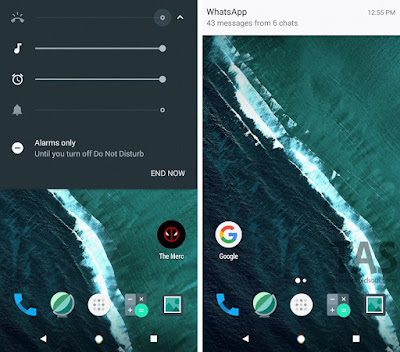
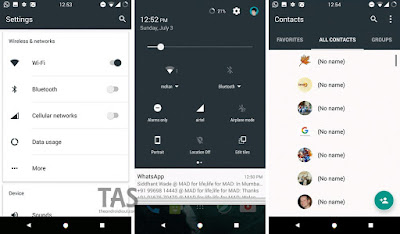
More Screenshots here
To install, know that you need a CM13 custom ROM installed on your device, or any other ROM which supports CM13 theme engine. There are some devices that come with Cyanogen OS pre-loaded, and for such devices, there is no need to hunt for CM13 ROM. Installing CM13 isn’t a straightforward thing as it needs lots of preparation: TWRP recovery and/or root and/or bootloader unlock, etc.
Download CM13 Nougat Theme.
For More Keep Checking Android Custom ROM Fix ™®
That’s all. We hope this guide serves you well. If there’s anything you’d like to be added/changed on this page, PLZ Use the comment box below to contribute more ideas & Suggestions .
Like this post? PLZ Hit the share buttons below to share this article with your friends on Facebook, Google + and Twitter.
Want the latest Updates Sign up for our newsletters!
PLZ Follow Us On Flipboard 4 More Latest Updates.
Best Regards.™
Available link for download

Thursday, December 1, 2016
Galardón MadrI D a la patente Liliac de Alise Devices alisedevices elevenpaths Liliac
Galardón MadrI D a la patente Liliac de Alise Devices alisedevices elevenpaths Liliac
 |
| Figura 1: Galardón madri+d a la patente Liliac de Alise Devices |
En abril de 2015, como parte de la toma de un porcentaje de la compañía por parte de Telefónica, yo me incorporé al Consejo de Administración de la empresa y he podido seguir de cerca el trabajo constante del equipo en el desarrollo nuevas medidas de seguridad, como la versión a todo color de su tecnología y en el cierre de acuerdos estratégicos para la industrialización de su tecnología.
Figura 2: Billetes Falsos en la Deep Web y Liliac de Alise Devices
Si bien en Alise Devices se dedican a la seguridad física, como la protección de billetes o documentos de identidad contra la falsificación, hay que destacar de su CEO Beatriz Cerrolaza (@alisedevices) y el resto del equipo el esfuerzo por innovar, el trabajo duro y constante y la convicción de que la seguridad debe proteger a todos los usuarios de forma fácil y eficiente. Valores que aprecio en el mundo laboral, sin duda y por lo que la han entrevistado recientemente.
El camino es largo, y por eso no hay que detenerse en el proceso. Hay que seguir innovando y mejorando, y aquella patente inicial que dio lugar a Liliac fue evolucionada para soportar el Full Color, como ya os conté en el artículo de "Cómo evitar la falsificación de documentos y billetes a todo color", y que podéis ver cómo es en este vídeo:
Figura 4: Liliac 2.0 Full Color de Alise Devices
Todo ese trabajo ha culminado recientemente con la obtención por parte de Liliac del galardón Accésit a las patente de base tecnológica que han concedido en los premios MadrI+D, y por lo que quiero felicitar a todo el equipo de Alise Devices.
 |
| Figura 5: Parte del equipo de Alise Devices recibiendo el galardón |
No es fácil hacer algo nuevo e innovador en el mundo de la seguridad, y como lo han hecho ellos, saliendo desde la Universidad, montando su empresa y avanzando día a día es encomiable. ¡Enhorabuena chicos!
Saludos Malignos!
Sigue Un informático en el lado del mal - Google+ RSS 0xWord

Available link for download
Saturday, November 12, 2016
Google Phone app for Nexus Android One devices updated with warning for potential spam calls
Google Phone app for Nexus Android One devices updated with warning for potential spam calls

One benefit of owning a Nexus device that’s often highlighted is that you get updates directly from Google, typically giving you new features before most other Android users. There are other benefits, though, including the one that Google is focusing on today.
Google says that it’s now updating the Google Phone app on Nexus and Android One devices. With this update, you’ll get a warning when you’re receiving a phone call from a suspected spam caller.

from PhoneDog.com - Latest videos, reviews, articles, news and posts http://ift.tt/2a9QYN7
via IFTTT
Available link for download
Monday, November 7, 2016
Android 6 0 Marshmallow coming to devices soon
Android 6 0 Marshmallow coming to devices soon
Posted by, Dave Burke, VP of Engineering, Android
Starting next week, Android 6.0 Marshmallow will begin rolling out to supported Nexus devices around the world, including Nexus 5, Nexus 6, Nexus 7 (2013), Nexus 9, Nexus Player, and Android One. At the same time, we’ll be pushing the Android 6.0 source to the Android Open Source Project (AOSP), which marks the official beginning of public availability.
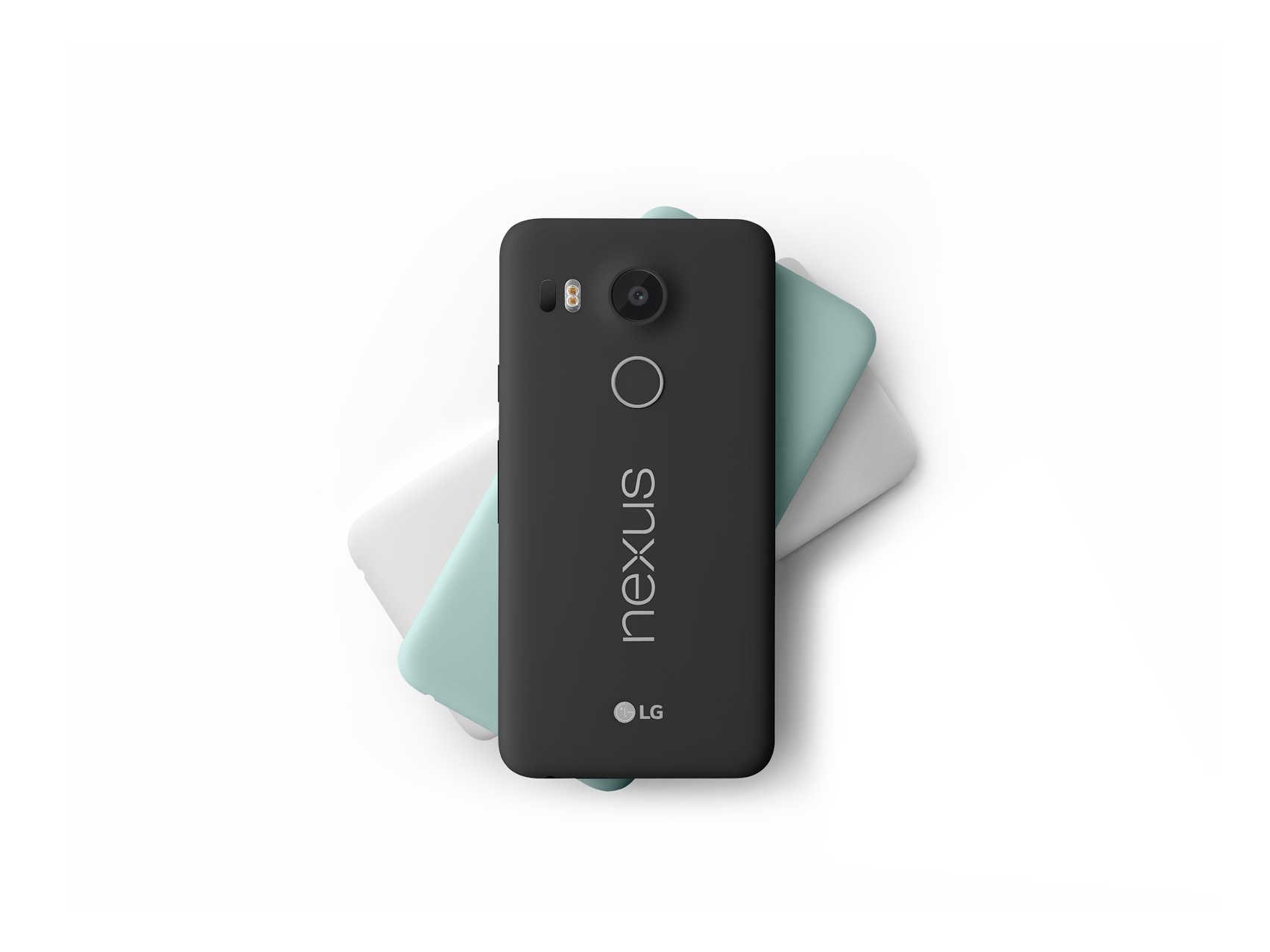
Today we also introduced two great new Nexus devices that will be among the first to run the Android 6.0 Marshmallow platform. These devices let your apps use the latest platform features and take advantage of the latest hardware optimizations from our partners. Let’s take a look at how to make sure your apps look great on these new devices.
Introducing Nexus 5X and Nexus 6P
 Nexus 5X |  Nexus 6P |
The Nexus 5X is built in partnership with LG. It’s equipped with a 5.2-inch FHD LCD 1080p display, a Snapdragon™ 808 processor (1.8 GHz hexa-core, 64-bit), and a 12.3 MP rear camera. Offering top-line performance in a compact, lightweight device.
The Nexus 6P, built in partnership with Huawei, has a 5.7-inch WQHD AMOLED display, Snapdragon™ 810 v2.1 processor (2.0 GHz octa-core 64-bit), front-facing stereo speakers, and a 12.3 MP rear camera, all housed in a diamond-cut aluminum body.
Both devices have USB Type-C ports and fingerprint sensors, and include the latest hardware features for Android, such as: Android Sensor Hub, low-power Wi-Fi scanning with channel selection, batching, and BSSID hotlists, Bluetooth 4.2 with ultra low-power BLE notifications, and more.
Get your apps ready
Take some time to make sure your apps and games are ready to give your users the best mobile experience on these devices.
Check your assets
| Resolution | Screen size | Density | |
|---|---|---|---|
| Nexus 5X | 1920 x 1080 px (730 x 410 dp) | normal | 420 dpi |
| Nexus 6P | 2560 x 1440 px (730 x 410 dp) | normal | 560 dpi |
Nexus 5X has a quantized density of 420 dpi, which falls in between the xhdpi and xxhdpi primary density buckets. Nexus 6P has a density of 560 dpi, which falls in between the xxhdpi and xxxhdpi buckets. The platform will scale down any assets from a higher resolution bucket, but if those aren’t available, then it will scale up the assets from a lower-density bucket.
For best appearance in the launcher, we recommend that you provide at least an xxxhdpi app icon because devices can display large app icons on the launcher.
For the rest of your assets, you can consider using vector assets or optionally add versions for the next-higher density bucket. This provides a sharper visual experience, but does increase apk size, so you should make an appropriate decision for your app.
Make sure you are not filtered on Google Play
If you are using the <compatible-screens>: element in your AndroidManifest.xml file, you should stop using it because it’s not scalable to re-compile and publish your app each time new devices come out. If you must use it, make sure to update your manifest to add a new configuration for Nexus 5X, since it uses a new density bucket (420). Otherwise, your app may be filtered from Google Play on these devices.
Wrapping up M Developer Preview
After three preview releases, and with the final OTA coming soon, it’s time to wrap up the Android M Developer Preview. The feedback you’ve provided has helped make Android 6.0 a great platform for apps and games. Developers in more than 200 countries have been using the Developer Preview to get their apps ready for Android 6.0 Marshmallow users everywhere.
More developer resources
If you haven’t taken a look at Android 6.0 Marshmallow yet, visit developer.android.com/mm for complete information about about what’s new for developers and important changes to plan for in your apps — runtime permissions, Doze and App Standby idle modes, Auto Backup for Apps, fingerprint support, and others.
We’ve also produced a playlist of developer videos to help you get the most out of all the new features in Android 6.0 Marshmallow. Check it out below.
Final testing and updates
Now is the time to finish up testing and prepare for publishing. You can use the Developer Preview 3 system images for final testing until early October. After the Android 6.0 public release, you’ll be able to download final images from the Nexus factory images page, and final emulator images from Android Studio.
Reminder: Devices flashed with an M Developer Preview build won’t receive the Android 6.0 update automatically. You’ll need to manually flash those devices to a public released image first.
Upload your apps to Google Play
When your apps are ready, you can update them to Google Play via the Developer Console on all release channels (Alpha, Beta & Production). For apps that target API level 23, Google Play will provide the new optimized download and autoupdate flow based on the runtime permissions model in Android 6.0. Give it a try!
To make sure that your updated app runs well on Android 6.0 Marshmallow and older versions, we recommend that you use the newly improved beta testing feature on Google Play to get early feedback. You can then do a staged rollout as you release the new version to all users.
What’s next?
In mid-October, we’ll be turning down the M Developer Preview community and the M Developer Preview issue tracker. If youve filed bugs against the preview, and youd like to keep these open against the Android 6.0 final builds, you can file a new issue in the AOSP issue tracker.
Thanks to everyone who participated in the Android M Developer Preview. Let us know how this year’s preview met your needs by taking a short survey. Your feedback helps shape our future releases.
Available link for download
Sunday, October 23, 2016
Google Daydream VR ‘Daydream ready’ phones and compatible devices
Google Daydream VR ‘Daydream ready’ phones and compatible devices
Googles Daydream VR platform is probably a little confusing to you right now, especially when it comes to which devices will support it. This is understandable, because Google still hasnt published its hardware spec and the so the exact requirements for a phone to be considered Daydream-ready are not yet clear. To confuse things even further, we also have the concept of Daydream-compatible to deal with. So lets take a look at the official Daydream VR ready phones and those likely to be compatible with the platform.
 See also: Does Daydream have what it takes to make VR mainstream?
 What is Daydream-ready?
Daydream-ready is the term Google is giving to next-generation devices that will have the necessary low latency sensors, low persistence display and minimum CPU/GPU performance to satisfactorily deliver Daydream VR content. As Google VR head Clay Bavor said at I/O: "We want to hold a very high quality bar, and for that to happen all the components need to be just right."

This is also why Bavor said that it is highly unlikely that any current smartphones (at the time in May) would get Daydream-ready branding. The reason is primarily down to two things: the lack of the necessary sensors and the absence of a low persistence display. But this refers to smartphones. There are also head-mounted displays (HMDs) to consider. Heres what Google has said about Daydream VR HMDs:
Daydream-ready headsets are designed for the high-quality mobile VR experiences that Daydream enables. Unlike the Google Cardboard viewer, they are designed for extended use. Instead of a trigger button, users interact with VR applications using the Daydream controller.
So you can see theres a split between the high-end Daydream VR experience and the more accessible Cardboard VR experience. Think of these experiences as two ends of the Google VR spectrum. They may be vastly different in feel and hardware but they are still part of the same axis. This is where Daydream compatibility comes in.

What is Daydream-compatible?
First, it must be noted that Daydream-compatibility is not something Google talks about. Naturally, Googles focus is on the next-gen hardware that will fully deliver its vision for Daydream content.
But there is already a huge base of Android users already invested in VR, including over a million Gear VR users, so Google would be foolish to ignore them and focus only on future users. This is where the (as yet unconfirmed) theory of Daydream VR-compatible devices comes in.
Google would be foolish to ignore the existing base of Android users already invested in VR and focus only on future users.
While the Galaxy S7 probably doesnt feature the sensors required to be considered Daydream-ready, it is feasible that, by meeting the vast majority of the other Daydream VR requirements, it could be considered Daydream-compatible. This would mean its not quite up to Googles standards but is close enough, kind of like the "Works with Google Cardboard" branding we already see a lot of.
Daydream compatible devices would thus be capable of running Daydream VR content, but the SDK would either disable those features the hardware is incapable of delivering or "roll back" to Cardboard VR when necessary. This is the same basic premise that allows the Nexus 6P (which is officially not Daydream-ready) to be the reference device for Daydream VR development. Its not Daydream-ready but it is Daydream-compatible.

Again, Daydream VR-compatible devices are purely speculative for now, but it would make a lot of sense for Google to allow Daydream content to run on less-than-Daydream-ready hardware. Partially to give the platform an instant user base without demanding users make a new device purchase running Android 7.0 Nougat.
But also because it would allow existing Android users and developers to get a feel for Daydream VR and hopefully convince them to purchase the necessary hardware for the full experience. If Google decides to add support for external sensors (which could appear as accessory mounts for existing phones), there might be even more Daydream VR-ready phones already around.
Google may also add support for external sensors to enable Daydream VR compatibility for almost-there devices.
Confirmed Daydream-ready phones
So far, only a few Daydream-ready phones have been announced but a few more recent devices will possibly be included to the list. But until the official hardware spec is published, we cant say for sure. Heres the confirmed list so far.
ZTE Axon 7

The first official Daydream VR-ready phone to be announced was the ZTE Axon 7. Priced at just $399, the Axon 7 offers a pretty compelling package, especially when it includes support for Googles VR platform. The ZTE Axon 7 specs also gave us our first hint at the minimum spec required for Daydream-readiness, including the Snapdragon 820, an AMOLED display and 4 GB of RAM.
Asus Zenfone 3 Deluxe

Even though the high-end version of the Zenfone 3 Deluxe (with 256 GB ROM and 6 GB of RAM) recently got a spec bump to the Snapdragon 821, both the Snapdragon 820-equipped models are also Daydream-certified. Considering all three of these phones have a Full HD Super AMOLED display, QHD is clearly no longer the benchmark resolution for Daydream VR phones.
 See also: Which phones come with a Qualcomm Snapdragon 820 processor?
 Daydream-ready specs
The following specs are absolutely not official, they are simply drawn from the list of already-announced Daydream-ready phones. First up, the Snapdragon 820 is the minimum chipset required for the CPU and GPU performance expected by Google and 4 GB of RAM looks to be the minimum memory requirement.
On the display front, at least a Full HD OLED display with low persistence is also necessary. Prior to the announcement of the three Zenfone 3 Deluxe models (which have Full HD resolution), it looked like QHD would be the minimum resolution required, but that now seems to have been relaxed.
As Qualcomm notes in its VR Software Development Kit notes for the Snapdragon 820, VR also requires "predictive head position processing" which the Qualcomm Hexagon DSP includes.
Of course, all devices will need to be running Android 7.0 Nougat to take advantage of its Sustained Performance Mode for VR too.

Possible Daydream-ready phones
Based on the specs mentioned above, there are a few existing devices that could theoretically be Daydream-ready. The Moto Z and Moto Z Force, Snapdragon versions of the Galaxy S7, S7 Edge and S7 Active and the OnePlus 3 all have the Snapdragon 820, QHD OLED displays and at least 4 GB of RAM.
The LG G5, HTC 10, Sony Xperia X Performance and LeEco Le Max Pro all have LCD displays and are thus unlikely to be Daydream certifiable.
The other big requirement – and more than likely the reason none of the OLED phones listed above have come out as Daydream-ready – is that they either do not have the necessary low latency sensors or low persistence display demanded by Google.
Most current phones either do not have the necessary low latency sensors or low persistence display demanded by Google.
This is probably why Clay Bavor said it was unlikely any current phones would get retroactive Daydream-ready certification. But looking forward is a different story: it stands to reason the upcoming Galaxy Note 7 will be Daydream-ready and the same is likely also true for the Huawei Mate 9 and Mate S2 and LG V20. But until everything is made official we cant say for sure.
Are you holding out for a Daydream VR ready phone? How big do you think Daydream VR will be?
Also read: Everything you need to know about Augmented Reality
from Android Authority http://ift.tt/29SeLCY
via IFTTT
Available link for download
Sunday, October 9, 2016
Gorilla Glass 5 official coming to devices later this year
Gorilla Glass 5 official coming to devices later this year
Corning’s Gorilla Glass has been giving us smartphones with toughened displays for years now, and today the latest version of Gorilla Glass has been revealed.

from PhoneDog.com - Latest videos, reviews, articles, news and posts http://ift.tt/29UCuUh
via IFTTT
Available link for download
Wednesday, August 31, 2016
How to use SP Flash Tool to fix MTK devices
How to use SP Flash Tool to fix MTK devices

If you are an Android geek & love to play with custom ROMs, recoveries & Kernels, one day youll encounter a hard bricked device. Now what does hard brick mean? If you cant boot up your device, cannot get into recovery mode or see boot logo this would actually leave your device in a state where it is not more than a brick. SP Flash tool is an application for Windows & linxu which you could find very useful in fixing extreme cases of a bricked MTK Android. SP Flash Tool also known as Smartphone Flash Tool provides many options like flashing custom or stock recoveries or Kernel (boot.img). As Mediatek Smartphone dont have an Official tool for any such problems, SP Flash tool is really a boon for Mediatek Smartphone users. To learn more about this tiny yet effective tool, refer our guide: SP Flash tool - Complete Guide. Now, without wasting much time, lets get started with unbricking your Smartphone.
- A PC with Windows or Linux OS.
- USB Cord
- Manually install VCOM drivers on the PC
- Your bricked Android device.
- Original/Working Stock ROM (Do a proper research as flashing the wrong ROM would permanently brick your device)
- Download SP Flash tool Latest version
- Open Device manager from My computer. Click on any item & Goto Actions > Add legacy hadware.
- Now, Press next & select Install drivers manually.
- Press next & click on Have disk.
- From the browse option, select the VCOM drivers as per your OS.
- Once its done. You will see a screen similar to this:


1. Remove the battery from the phone and slot it back in without booting the phone (If the battery is inbuilt then simply switch if off). Also, ensure theres no SD card in the phone (if theres an SD card slot)
2. Launch SP Flash Tool as Administrator
 | ||
| SP Flash Tool 3. Click on Scatter-loading option & browse to the scatter file of your Stock ROM. (You can find the scatter file with the original stock rom zip file)
|

4. Now, if you want to format your phone, Click Format at the top.
5. Once you are done with everything, click on the download button at the top of the window
 |
| Start flashing 6. Stop should now be prominent while other options should be grayed out 7. Connect the switched off phone (with battery inside) to the PC via USB cord 8. A progress bar should start running 9. Disconnect the phone, remove the battery for 15 seconds (if removable), slot it back in then power up the phone.  Final words As the procedure is bit complex for newbies. However, I have tried to make it as simple as possible. Dont worry! if you are stuck at any point, you can contact us from the below comment form. |
Available link for download